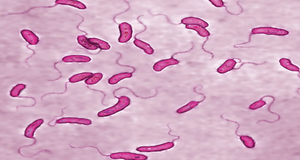
霍乱弧菌是一种革兰氏阴性细菌,其高度活跃,菌体呈逗点状,单鞭毛,属于弧菌科。霍乱弧菌存在于咸水或半咸水中,与浮游动物和贝类有关,可通过被污染的水源传播并感染宿主。
霍乱是一种严重的、可危及生命的腹泻疾病,如果不能够及时治疗,患者可在数小时内死亡。目前,近69个国家仍存在霍乱流行,每年约导致286万例霍乱病例和9.5万人死亡。
根据体表O抗原类型,霍乱弧菌可划分为200多个血清群。这些血清群中,O1和O139与霍乱的大流行有关,其中O1血清型可进一步分为两种生物型,即经典型(Cla)和El Tor型(ET)。自1817年以来,世界上共发生了七次霍乱大流行。Cla生物型被认为导致了前六次的霍乱大流行,而ET生物型取代Cla,导致了自1961年以来一直持续至今的第七次霍乱大流行。O139分离株首次发现于1992年的孟加拉国和印度,目前尚未传播到除亚洲以外的其他地区。
根据全基因组系统发育关系,霍乱弧菌可划分为9个谱系(L1-L9):L1菌株为O1血清型Cla型,L2菌株为O1血清型ET型,均为产毒谱系,分别导致了前六次与第七次霍乱大流行;L3菌株主要分离自美国墨西哥湾沿岸;L4、L7谱系为环境分离株,其与部分L3菌株(L3b)为非产毒霍乱弧菌(即缺失霍乱毒素编码基因ctxAB的霍乱弧菌);L5、L6、L8菌株分别分离于印尼苏拉威西,沙特阿拉伯、澳大利亚;L9菌株为非产毒霍乱弧菌。
Samples collection date:
Samples host information:
Biotype information:
Serotype information:
Samples MLST information:
Samples phylogroup information:
Samples Virulence information:
Samples Resistance information:
[1]Clemens J D, Nair G B, Ahmed T, Qadri F, Holmgren J. Cholera. Lancet. 2017;390(10101):1539–1549.
[2]Kanungo S, Azman AS, Ramamurthy T, Deen J, Dutta S. Cholera. Lancet. 2022;399(10333):1429-1440.
[3]Yoon SH, Waters CM. Vibrio cholerae. Trends Microbiol. 2019;27(9):806-807.
[4]Harris JB, LaRocque RC, Qadri F, Ryan ET, Calderwood SB. Cholera. Lancet. 2012;379: 2466–2476.
[5]Somboonwit C, Menezes L J, Holt D A, Sinnott J T, Shapshak P. Current views and challenges on clinical cholera. Bioinformation. 2017;13(12):405–409.
[6]Chatterjee SN, Chaudhuri K. Lipopolysaccharides of Vibrio cholerae. I. Physical and chemical characterization. Biochim Biophys Acta. 2003;1639: 65–79.
[7]Kaper JB, Morris JG Jr, Levine MM. Cholera. Clin Microbiol Rev. 1995;8(1):48-86.
[8]Hraib M, Alaidi S, Jouni S, Saad S, Muna M, et al. Cholera: An Overview with Reference to the Syrian Outbreak. Avicenna J Med. 2023;13(4):199-205.
[9]Mutreja A, Kim DW, Thomson NR, Connor TR, Lee JH, et al. Evidence for several waves of global transmission in the seventh cholera pandemic. Nature. 2011;477: 462–465.
[10]Wang H, Yang C, Sun Z, Zheng W, Zhang W, et al. Genomic epidemiology of Vibrio cholerae reveals the regional and global spread of two epidemic non-toxigenic lineages. PLoS Negl Trop Dis. 2020;14(2):e0008046.