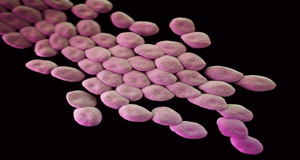
鲍曼不动杆菌是一种重要的革兰氏阴性菌,在自然界中分布广泛。鲍曼不动杆菌能够引起皮肤和软组织感染、尿路感染、脑膜炎、菌血症和肺炎,在易感患者中较少出现社区获得性感染。目前,鲍曼不动杆菌临床株对所有一线抗生素表现出耐药性,多数情况下,多粘菌素、替加环素和氨苄西林/舒巴坦已成为广泛耐药菌株的最后治疗手段。鉴于此,世界卫生组织将耐碳青霉烯类鲍曼不动杆菌列为全球优先关注的抗生素耐药细菌中的“关键”病原体。
鲍曼不动杆菌的全球传播由三个主要国际克隆谱系(IC 1-3)以及至少6个其他流行性克隆谱系推动。流行性鲍曼不动杆菌通常对多种抗菌药物具有耐受性。此外,它们还具有一些致病特性,可刺激非生物表面的生物膜生长、提高对干燥的耐受性;可黏附于人上皮细胞,有助于细菌在医院中持久存在和在感染患者中的传播。IC1和IC2菌株携带大量的耐药决定簇并在全球30多个国家中广泛传播。IC2菌株对各类抗菌药的耐药率普遍高于其他基因型,其耐药特征主要表现为通过水平基因转移获得碳青霉烯类抗生素耐药性。IC3在过去10年中全球报告数量相对较少流行程度略有下降,且病例来自于非人类。IC5在拉丁美洲最最常见,与IC4相比,IC5菌株耐药决定簇更广。IC6主要分布在俄罗斯、白俄罗斯、意大利和南美国家。IC7在世界不同地区均有报道,包括欧洲、亚洲、北美和南美。IC8菌株零散分布于印度、阿富汗、德国、孟加拉国、中国和菲律宾等地。IC9目前主要出现在中东和北非地区。
鲍曼不动杆菌携带强侵袭性毒力因子,如外膜蛋白、脂多糖和磷脂酶。外膜蛋白A(OmpA)可结合宿主上皮细胞和初代单核细胞衍生的巨噬细胞并转移至细胞核,在体外诱导宿主细胞死亡。OmpA还能刺激线粒体产生活性氧,并诱导树突状细胞发生早期凋亡和迟发性坏死。磷脂酶C(PLC)是由院内病原体产生的一种关键酶,能催化磷脂分解。PLC主要降解宿主细胞膜或粘膜屏障磷脂,从而引发疾病。磷脂酶D是一种分泌蛋白,含有两个活性位点,可催化磷脂酰胆碱转化为磷脂酸和胆碱,从而使细菌能够深入宿主组织以逃避宿主攻击。
Samples collection date:
Samples host information:
O type information:
K type information:
Samples MLST information:
Samples phylogroup information:
Samples Virulence information:
Samples Resistance information:
[1] Sajan P, Wen Y P, Zhouqi Q, et al. Clinical Characteristics of Hydrocephalus Following the Treatment of Pyogenic Ventriculitis Caused by Multi/Extensive Drug-Resistant Gram-Negative Bacilli, Acinetobacter Baumannii, and Klebsiella Pneumoniae[J]. Frontiers in Surgery, 2022, 9: 854627-854627.
[2] Dickstein Y, Lellouche J, Ben Dalak Amar M, et al. Treatment Outcomes of Colistin- and Carbapenem-resistant Acinetobacter baumannii Infections: An Exploratory Subgroup Analysis of a Randomized Clinical Trial[J]. Clin Infect Dis, 2019, 69(5): 769-776.
[3] Bartal C, Rolston K V I, Nesher L. Carbapenem-resistant Acinetobacter baumannii: Colonization, Infection and Current Treatment Options[J]. Infect Dis Ther, 2022, 11(2): 683-694.
[4] WHO. Global priority list of antibiotic-resistant bacteria to guide research, discovery, and development of New antibiotics[J]. Geneva: World Health Organization, 2017, 32(1).
[5] Zarrilli R, Pournaras S, Giannouli M, et al. Global evolution of multidrug-resistant Acinetobacter baumannii clonal lineages[J]. Int J Antimicrob Agents, 2013, 41(1): 11-9.
[6] Holt K, Kenyon J J, Hamidian M, et al. Five decades of genome evolution in the globally distributed, extensively antibiotic-resistant Acinetobacter baumannii global clone 1[J]. Microb Genom, 2016, 2(2): e000052.
[7] Klotz P, Higgins P G, Schaubmar A R, et al. Seasonal Occurrence and Carbapenem Susceptibility of Bovine Acinetobacter baumannii in Germany[J]. Front Microbiol, 2019, 10: 272.
[8] Vijayakumar S, Jacob J J, Vasudevan K, et al. Genomic Characterization of Mobile Genetic Elements Associated With Carbapenem Resistance of Acinetobacter baumannii From India[J]. Front Microbiol, 2022, 13: 869653.
[9] J S M, Adela C-G, K P S, et al. A novel class of microbial phosphocholine-specific phospholipases C[J]. Molecular microbiology, 2002, 46(3): 661-76.
[10] Antunes L C S, Visca P, Towner K J. Acinetobacter baumannii: evolution of a global pathogen[J]. Pathogens and Disease, 2014, 71(3): 292-301.
[11] Teng L Y, Siew T H. Acinetobacter baumannii subunit vaccines: recent progress and challenges[J]. Critical reviews in microbiology, 2023: 11-16.