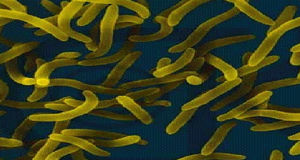
副溶血弧菌是一种革兰氏阴性、嗜盐、无芽孢病原菌。其存在于全球温带和热带海洋及沿海水域中。人感染副溶血弧菌通常与食用生的、未煮熟的,或受污染的贝类有关。感染副溶血弧菌后常引起急性、严重的胃肠炎和胃肠道出血,主要症状包括发烧、呕吐、腹泻和便血。此外,副溶血弧菌也是导致虾类发生急性肝胰腺坏死病的主要病原。
副溶血弧菌的血清型分型方案基于O抗原和K抗原,其包括10多种O型和70多种K型。副溶血弧菌感染病例中最常见的克隆群为O3:K6血清型及其变种。自1996年以来,O3:K6已在全球范围内流行。此外,O4:K12型菌株曾于1997年前后在美国太平洋西北部、2012年在美国大西洋沿岸和西班牙导致肠胃炎暴发。在中国,副溶血弧菌O4:K12血清型菌株分别于2006年、2010年、2011年和2014年在上海引发肠胃炎暴发。
副溶血性弧菌可分为4个种群(VppUS1、VppUS2、VppX 和 VppAsia),其与菌株的地理分布有关,且每个种群衍生出不同的克隆群。前两个种群的菌株主要局限于美国和北欧,其余菌株在世界各地均有分布,其中VppAsia种群菌株在亚洲占主导地位。种群内部和种群间的多样性与它们地理隔离期间通过遗传漂变逐渐分化而产生的多样性模式一致。
副溶血弧菌拥有多种毒力因子,除了众所周知的耐热直接溶血素(tdh)和/或tdh相关溶血素(trh)外,基因组测序还发现了两个III型分泌系统(T3SS1和T3SS2)。T3SS1在副溶血弧菌中普遍存在,与细胞毒性活动相关;T3SS2主要存在于临床分离株中,与肠毒性相关。T3SS2有T3SS2α和T3SS2β两种类型,其中tdh与T3SS2α编码基因相邻,均位于VPaI-7致病岛上;而trh和T3SS2β基因相邻,均位于VPaI-7的同源基因组岛上。副溶血弧菌有两种VI型分泌系统(T6SS1和T6SS2)。T6SS1在临床分离株中更常见,其有助于粘附到宿主细胞上。此外, 副溶血弧菌有七个基因组岛(VPaI-1~7)。VPaI-1、VPaI-4、VPaI-5 和 VPaI-6 仅在流行株中发现,其基因组大小从10-81 kb不等,平均GC含量低于整个基因组,提示它们可能通过水平基因转移获得。
除青霉素类抗生素(如青霉素、氨苄青霉素和阿莫西林)外,副溶血弧菌通常对大多数兽医和人类使用的抗生素敏感,如氯霉素、四环素和喹诺酮。虽然轻度感染无需治疗,但疾病严重或长期患病时有时会使用抗生素。据报道,副溶血弧菌在水产养殖过程中表现出多重耐药性。
Samples collection date:
Samples host information:
Serotype information:
Serotype information:
Samples MLST information:
Samples phylogroup information:
Samples Virulence information:
Samples Resistance information:
[1] Martinez-Urtaza J, Baker-Austin C. Vibrio parahaemolyticus[J]. Trends Microbiol, 2020, 28(10): 867-868.
[2] Yeung P S, Boor K J. Epidemiology, pathogenesis, and prevention of foodborne Vibrio parahaemolyticus infections[J]. Foodborne Pathog Dis, 2004, 1(2): 74-88.
[3] DePaola A, Ulaszek J, Kaysner C A, et al. Molecular, serological, and virulence characteristics of Vibrio parahaemolyticus isolated from environmental, food, and clinical sources in North America and Asia[J]. Appl Environ Microbiol, 2003, 69(7): 3999-4005.
[4] Tchelet D, Keppel K, Bosis E, et al. Vibrio parahaemolyticus T6SS2 effector repertoires[J]. Gut Microbes, 2023, 15(1): 2178795.
[5] Han D, Yu F, Tang H, et al. Spreading of Pandemic Vibrio parahaemolyticus O3:K6 and Its Serovariants: A Re-analysis of Strains Isolated from Multiple Studies[J]. Front Cell Infect Microbiol, 2017, 7: 188.
[6] Zhao L, Chen H, Didelot X, et al. Co-existence of multiple distinct lineages in Vibrio parahaemolyticus serotype O4:K12[J]. Microb Genom, 2020, 6(12): mgen000287.
[7] Yang C, Pei X, Wu Y, et al. Recent mixing of Vibrio parahaemolyticus populations[J]. Isme j, 2019, 13(10): 2578-2588.
[8] Makino K, Oshima K, Kurokawa K, et al. Genome sequence of Vibrio parahaemolyticus: a pathogenic mechanism distinct from that of V cholerae[J]. Lancet, 2003, 361(9359): 743-9.
[9] Okada N, Iida T, Park K S, et al. Identification and characterization of a novel type III secretion system in trh-positive Vibrio parahaemolyticus strain TH3996 reveal genetic lineage and diversity of pathogenic machinery beyond the species level[J]. Infect Immun, 2009, 77(2): 904-13.
[10] Yu Y, Yang H, Li J, et al. Putative type VI secretion systems of Vibrio parahaemolyticus contribute to adhesion to cultured cell monolayers[J]. Arch Microbiol, 2012, 194(10): 827-35.
[11] Boyd E F, Cohen A L, Naughton L M, et al. Molecular analysis of the emergence of pandemic Vibrio parahaemolyticus[J]. BMC Microbiol, 2008, 8: 110.
[12] Elmahdi S, DaSilva L V, Parveen S. Antibiotic resistance of Vibrio parahaemolyticus and Vibrio vulnificus in various countries: A review[J]. Food Microbiol, 2016, 57: 128-34.
[13] Hasan M, Azim K F, Imran M A S, et al. Comprehensive genome based analysis of Vibrio parahaemolyticus for identifying novel drug and vaccine molecules: Subtractive proteomics and vaccinomics approach[J]. PLoS One, 2020, 15(8): e0237181.