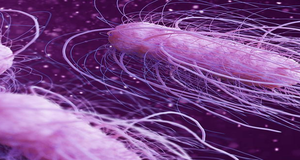
沙门氏菌是一种革兰氏阴性杆菌,具有多种形态,通常呈现为短杆状、无芽孢、周身鞭毛。其在自然界中分布广泛,通常在动物粪便、土壤、食品和水源中能够分离。沙门氏菌能感染人、家禽、家畜以及野生动物等多种宿主。沙门氏菌属包括两个种:S. enterica和S. bongori。S. enterica进一步分为七个亚种:I(S. enterica subsp. enterica)、II(S. enterica subsp. salamae)、IIIa(S. enterica subsp. arizonae)、IIIb(S. enterica subsp. diarizonae)、IV(S. enterica subsp. indica)、VI (S. enterica subsp. houtenae)和VII(S. enterica subsp. VII (Newport) )。
沙门氏菌具有复杂的抗原结构,一般可分为3种类型:菌体(O)抗原、鞭毛(H)抗原和表面(Vi)抗原。迄今为止,已知的沙门氏菌中存在40多种O抗原和114种H抗原,从可能的组合中,已鉴定出2600多种沙门氏菌血清型,其中至少50%属于S. enterica subsp. enterica。沙门氏菌血清型基于其是否可引起系统性疾病或局部性胃肠炎分为伤寒和非伤寒血清型。大多数沙门氏菌血清型可以定植于多种宿主(如S. Typhimurium和S. Enteritidis),相对较少的血清型适应特定宿主(如S. Typhi只感染人)。各个地区致病菌的血清型各不相同,伤寒沙门氏菌(血清型为Typhi和Paratyphi A)常见于东南亚,非伤寒沙门氏菌血清型常见于非洲。
作为定植在宿主细胞的先决条件,沙门氏菌具备一系列与宿主表面结合的毒力因子,例如菌毛粘附素1型菌毛(Fim)、质粒编码的菌毛(Pef)、long polar fimbriae(Lpf)、thin aggregative fimbriae(Agf)、non-fimbrial autotransported adhesins MisL和T1SS分泌的粘附素。沙门氏菌致病岛 1(SPI-1)通过沙门氏菌亚种的最近共同祖先入侵宿主细胞,SPI-2在S. enterica和S. bongori分化期间可在巨噬细胞中复制。此外,沙门氏菌可利用 T3SS 依赖性效应蛋白分泌进入宿主细胞质溶胶,促进其侵袭、细胞内生存和复制,操纵宿主细胞信号级联反应。
Samples collection date:
Samples host information:
Serotype information:
Samples H1 type information:
Samples H2 type information:
Samples MLST information:
Samples phylogroup information:
Samples Virulence information:
Samples Resistance information:
[1] Seif Y, Kavvas E, Lachance J-C, et al. Genome-scale metabolic reconstructions of multiple Salmonella strains reveal serovar-specific metabolic traits[J]. Nature Communications, 2018, 9(1): 3771.
[2] Gómez-Baltazar A, Godínez-Oviedo A, Vázquez-Marrufo G, et al. Genomic analysis of the MLST population structure and antimicrobial resistance genes associated with Salmonella enterica in Mexico[J]. Genome, 2023, 66(12): 319-332.
[3] Matsuoka D M, Costa S F, Mangini C, et al. A nosocomial outbreak of Salmonella enteritidis associated with lyophilized enteral nutrition[J]. Journal of Hospital Infection, 2004, 58(2): 122-127.
[4] Eng. S-K, Pusparajah. P, Mutalib. N-S A, et al. Salmonella: A review on pathogenesis, epidemiology and antibiotic resistance[J]. Front Life Sci, 2015, 8: 284–293.
[5] Thames H T, Sukumaran A T. A Review of Salmonella and Campylobacter in Broiler Meat: Emerging Challenges and Food Safety Measures[J]. Foods, 2020, 9(6):776.
[6] Crump J A, Mintz E D. Global trends in typhoid and paratyphoid Fever[J]. Clin Infect Dis, 2010, 50(2): 241-6.
[7] Singh V. Salmonella serovars and their host specificity[J]. J. Vet. Sci. Anim. Husb, 2013, 1(301): 10.15744.
[8] Bäumler A, Fang F C. Host specificity of bacterial pathogens[J]. Cold Spring Harb Perspect Med, 2013, 3(12): a010041.
[9] WHO. WHO Estimates of the Global Burden of Foodborne Diseases: Foodborne Disease Burden Epidemiology Reference Group 2007–2015[EB/OL]. (2024-2024.05.14https://www.who.int/publications/i/item/9789241565165.
[10] Barlag B, Hensel M. The giant adhesin SiiE of Salmonella enterica[J]. Molecules, 20(1): 1134-50.
[11] Desai P T, Porwollik S, Long F, et al. Evolutionary Genomics of Salmonella enterica Subspecies[J]. mBio, 2013, 4(2):e00579-12.
[12] Bao H, Wang S, Zhao J H, et al. Salmonella secretion systems: Differential roles in pathogen-host interactions[J]. Microbiol Res, 2020, 241: 126591.