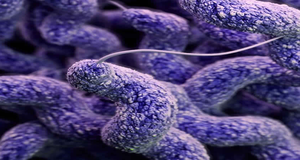
小肠结肠炎耶尔森菌(Yersinia enterocolitica)是一种兼性厌氧、革兰氏阴性杆菌或球杆菌,在自然界中分布广泛。它能够感染多种宿主(包括人、猪、狗、猫、牛、羊及野生动物),是一种人畜共患性病原菌。迄今为止,小肠结肠炎耶尔森菌已经鉴定到六种生物型(1A、1B、2、3、4 和 5)和 70 多种血清型。其中,生物型1B菌株被认为在小鼠中拥有高毒性和致死性;生物型1A菌株由于缺乏毒力质粒pYV被认为几乎无毒性;生物型2-5菌株毒力较低。尽管欧洲疾病预防控制中心已将生物型1A小肠结肠炎耶尔森菌定义为非致病性且无需报告的细菌,但包括1A在内的所有生物型都可从临床样本中分离到。使用大蜡螟进行的毒力实验表明,所有小肠结肠炎耶尔森菌都具有致病性。
2021年,耶尔森菌病在欧盟报告的人畜共患病中位列第三,其主要致病菌为小肠结肠炎耶尔森菌。小肠结肠炎耶尔森菌原发性感染主要影响胃肠道,导致腹泻、发烧、胃痉挛、呕吐和便血等症状。虽然其引发的疾病通常具有自限性,但也存在继发性并发症包括败血症、局部感染、回肠炎、阑尾炎和反应性关节炎。
小肠结肠炎耶尔森菌能产生β-内酰胺酶,因此对氨苄青霉素,阿莫西林和第一代头孢菌素具有天然耐受性。此外,质粒在小肠结肠炎耶尔森菌的毒力中也发挥着重要作用。在O型小肠结肠炎耶尔森菌中,仅少数(O:3、O:5,27、O:8和O:9)菌株携带70 kb的毒力质粒。多篇研究报道了小肠结肠炎耶尔森菌的细胞表面结构,这些结构包括外膜糖脂,如脂多糖和肠杆菌共同抗原,以及仅存在于有毒性的小肠结肠炎耶尔森菌中的几种细胞表面粘附蛋白:Inv、YadA和Ail。yadA基因位于耶尔森菌毒力质粒上,Ail、Inv、LPS和ECA由染色体编码。这些结构为细菌提供了粘附能力以及对抗菌肽和宿主先天免疫反应机制的抗性。
Samples collection date:
Samples host information:
Serotype information:
Samples MLST information:
Samples phylogroup information:
Samples Virulence information:
Samples Resistance information:
[1] Bottone E J. Yersinia enterocolitica: the charisma continues[J]. Clinical Microbiology Reviews, 1997, 10(2): 257-276.
[2] Mikula K, Kolodziejczyk R, Goldman A. Yersinia infection tools—characterization of structure and function of adhesins[J]. Frontiers in Cellular and Infection Microbiology, 2013, 2: 169.
[3] Shoaib M, Shehzad A, Raza H, et al. A comprehensive review on the prevalence, pathogenesis and detection of Yersinia enterocolitica[J]. RSC Adv, 2019, 9(70): 41010-41021.
[4] Lucero-Estrada C, Favier G I, Escudero M E. An overview of Yersinia enterocolitica and related species in samples of different origin from San Luis, Argentina[J]. Food Microbiology, 2020, 86: 103345.
[5] Hunter E, Greig D R, Schaefer U, et al. Identification and typing of Yersinia enterocolitica and Yersinia pseudotuberculosis isolated from human clinical specimens in England between 2004 and 2018[J]. J Med Microbiol, 2019, 68(4): 538-548.
[6] Alenizi D, Ringwood T, Redhwan A, et al. All Yersinia enterocolitica are pathogenic: virulence of phylogroup 1 Y. enterocolitica in a Galleria mellonella infection model[J]. Microbiology (Reading), 2016, 162(8): 1379-1387.
[7] EFSA, ECDC. The European Union One Health 2022 Zoonoses Report[J]. Efsa j, 2023, 21(12): e8442.
[8] Thwaites P A, Woods M L. Sepsis and siderosis, Yersinia enterocolitica and hereditary haemochromatosis[J]. BMJ Case Rep, 2017, 2017: bcr2016218185.
[9] Rodio D M, Bressan A, Ambrosi C, et al. Yersinia enterocolitica in Italy: A Case of Septicemia and Abdominal Aortic Aneurysm Infection[J]. Front Med (Lausanne), 2018, 5: 156.
[10] Fredriksson-Ahomaa M, Cernela N, Hächler H, et al. Yersinia enterocolitica strains associated with human infections in Switzerland 2001-2010[J]. Eur J Clin Microbiol Infect Dis, 2012, 31(7): 1543-50.
[11] McNally A, Thomson N R, Reuter S, et al. 'Add, stir and reduce': Yersinia spp. as model bacteria for pathogen evolution[J]. Nat Rev Microbiol, 2016, 14(3): 177-90.
[12] Białas N, Kasperkiewicz K, Radziejewska-Lebrecht J, et al. Bacterial Cell Surface Structures in Yersinia enterocolitica[J]. Archivum Immunologiae et Therapiae Experimentalis, 2012, 60(3): 199-209.