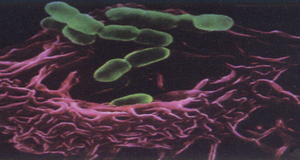
布鲁氏菌是一种革兰氏阴性、不运动细菌,属于变形菌门,α-变形菌纲,根瘤菌目,布鲁氏菌科。布鲁氏菌能引起布鲁氏菌病(布病),它是一种人畜共患的慢性传染性疾病。患布病的动物通常表现为不育、流产和产奶量下降等,对畜牧业的发展可造成巨大经济损失。
布鲁氏菌属目前包括12个物种,可根据其趋向性、致病性和宿主表型特征进行区分。人类布病感染主要由B. melitensis 和B. abortus两种布鲁氏菌引起,其存在明显的宿主偏好性。小型反刍动物(绵羊和山羊)的布病主要由B. melitensis引起,牛布病常由B. abortus引起。在牛与绵羊/山羊混合饲养的地区,牛也可能感染B. melitensis,小型反刍动物感染B. abortus而患布病。虽然人类对一些布鲁氏菌高度感染,但人只是其偶然宿主,且人与人之间的传播极为罕见。人类通常通过直接接触被感染动物的组织/血液,或食用污染的动物产品(包括未经巴氏消毒的牛奶和奶酪)感染布鲁氏菌。感染布病后的临床表现为非特异性急性症状,如发烧、不适、寒战、体重减轻和关节痛。在某些情况下,布病可发展为慢性症状,导致骨髓炎、睾丸炎和心内膜炎等其他病症。尽管世界卫生组织、联合国粮食及农业组织和世界动物卫生组织建议开展监测和根除布病计划,但该病仍然在许多地区流行。
布鲁氏菌缺乏多种已知的/经典的毒力因子,如芽孢、菌毛、细胞溶血素、外毒素、分泌蛋白酶、抗原变异、抗性特征、噬菌体编码毒素、毒力质粒以及荚膜。布鲁氏菌侵袭、建立感染以及在细胞内生存和复制所必需的毒力因子包括环状β-1,2-葡聚糖、VirB T4SS、病原体相关分子模式、双组份传感和调节系统BvrS/BvrR以及脂多糖。其他毒力因子包括外膜蛋白、BacA、SagA、BmaC、BetB、BtaE、MucR,以及与布鲁氏菌致病相关的基因组岛。
Samples collection date:
Samples host information:
Samples MLST information:
Samples phylogroup information:
Samples Virulence information:
Samples Resistance information:
[1] Suárez-Esquivel M, Chaves-Olarte E, Moreno E, et al. Brucella Genomics: Macro and Micro Evolution[J]. Int J Mol Sci, 2020, 21(20): 7749.
[2] Xiong X, Li B, Zhou Z, et al. The VirB System Plays a Crucial Role in Brucella Intracellular Infection[J]. Int J Mol Sci, 2021, 22(24): 13637.
[3] Coloma-Rivero R F, Flores-Concha M, Molina R E, et al. Brucella and Its Hidden Flagellar System[J]. Microorganisms, 2021, 10(1): 83.
[4] Akoko J M, Pelle R, Lukambagire A S, et al. Molecular epidemiology of Brucella species in mixed livestock-human ecosystems in Kenya[J]. Sci Rep, 2021, 11(1): 8881.
[5] Roop R M, 2nd, Barton I S, Hopersberger D, et al. Uncovering the Hidden Credentials of Brucella Virulence[J]. Microbiol Mol Biol Rev, 2021, 85(1): e00021-19.
[6] de Figueiredo P, Ficht T A, Rice-Ficht A, et al. Pathogenesis and immunobiology of brucellosis: review of Brucella-host interactions[J]. Am J Pathol, 2015, 185(6): 1505-17.
[7] Pereira C R, Cotrim de Almeida J V F, Cardoso de Oliveira I R, et al. Occupational exposure to Brucella spp.: A systematic review and meta-analysis[J]. PLoS Negl Trop Dis, 2020, 14(5): e0008164.
[8] Garin-Bastuji B, Mick V, Le Carrou G, et al. Examination of taxonomic uncertainties surrounding Brucella abortus bv. 7 by phenotypic and molecular approaches[J]. Appl Environ Microbiol, 2014, 80(5): 1570-9.
[9] Huy T X N, Nguyen T T, Kim H, et al. Brucella Phagocytosis Mediated by Pathogen-Host Interactions and Their Intracellular Survival[J]. Microorganisms, 2022, 10(10): 2003.