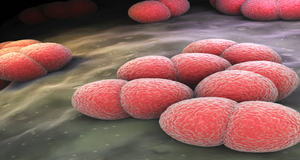
脑膜炎奈瑟菌属于变形菌门β-亚群革兰氏阴性球菌,1887年Weichselbaum首次从脑膜炎患者的脑脊液中分离。脑膜炎奈瑟菌极少致病,但可引起侵袭性脑膜炎球菌病(IMD)。脑膜炎奈瑟菌通常定植于人的鼻咽部上皮组织,并通过气溶胶飞沫或与受感染的液体(如唾液)接触传播。当脑膜炎球菌穿过鼻咽部上皮组织进入血液时,就会引发IMD,导致败血症和/或脑膜炎的快速发作。
MLST最初为脑膜炎球菌开发,现在已广泛应用于细菌病原体的分型。脑膜炎球菌MLST分型方案根据7个管家基因abcZ、adk、aroE、fumC、gdh、pdhC、pgm的等位基因,将菌株划分为不同的序列类型。共享4个或更多等位基因的ST型被归类为一个克隆复合体,并以假定的“祖先”ST型命名。最早的血清分型方案基于细菌表面多糖荚膜与免疫血清的凝集反应,依据这种分型方法共定义了13种脑膜炎球菌血清型(A、B、C、D、E、H、I、K、L、W、X、Y和Z),其中A、B、C、W、X、Y这六个血清型菌株是引起人类疾病的主要病原体,同时这些致病菌又可进一步归属于11个克隆复合体(cc1、cc4/5、cc8、cc11、cc18、cc32、cc41/44、cc103、cc269、cc334 和 cc461)。这些克隆复合体因具有高侵袭性或高毒力特征被称为高侵袭性谱系。在流行病学监测中,高侵袭性谱系常和疾病发生存在强关联性,而像cc53这样的谱系则仅表现为无症状携带状态。此外,部分谱系如cc22、cc23、cc60、cc162、cc174、cc213、cc364和cc4821与疾病发生的关联强度相对较弱。
β-内酰胺类抗生素(包括青霉素、氨苄西林和头孢曲松)、氟喹诺酮类药物(如环丙沙星)和氯霉素均被用作IMD的经验性治疗,其中头孢曲松常是首选抗生素。IMD的治疗通常不会导致耐药变异的传播。
疫苗接种是预防和控制IMD的主要手段。常用的脑膜炎球菌疫苗有两种:多糖结合疫苗,其中覆盖MenACWY的四价疫苗最常用(商品名Nimenrix、Menactra和Menveo);以及基于外膜囊泡的多价蛋白疫苗(商品名Bexsero和Trumenba)。
脑膜炎球菌最重要的毒力因子与其在口咽部的定植有关,包括免疫球蛋白A1(IgA1)蛋白酶、抗吞噬多糖荚膜以及一系列能与上皮结合的细菌粘附素。IgA1蛋白酶是一种位点特异性丝氨酸蛋白酶。它在铰链区裂解抗体分子,分离Fab和Fc区,从而防止病原体被粘液纤毛清除,促进其附着在呼吸道上皮中。除了对抗吞噬作用外,脑膜炎奈瑟菌的多糖荚膜可排斥粘液,阻碍粘液纤毛的清除。
Samples collection date:
Samples host information:
Serotype information:
Samples MLST information:
Samples phylogroup information:
Samples Virulence information:
Samples Resistance information:
[1] Schoen C, Kischkies L, Elias J, et al. Metabolism and virulence in Neisseria meningitidis[J]. Front Cell Infect Microbiol, 2014, 4: 114.
[2] Rouphael N G, Stephens D S. Neisseria meningitidis: biology, microbiology, and epidemiology[J]. Methods Mol Biol, 2012, 799: 1-20.
[3] Mikucki A, McCluskey N R, Kahler C M. The Host-Pathogen Interactions and Epicellular Lifestyle of Neisseria meningitidis[J]. Front Cell Infect Microbiol, 2022, 12: 862935.
[4] Pace D, Pollard A J. Meningococcal disease: clinical presentation and sequelae[J]. Vaccine, 2012, 30 Suppl 2: B3-9.
[5] Maiden M C, Bygraves J A, Feil E, et al. Multilocus sequence typing: a portable approach to the identification of clones within populations of pathogenic microorganisms[J]. Proc Natl Acad Sci U S A, 1998, 95(6): 3140-5.
[6] Zhao P, Xu L, Zhang A, et al. Evolutionary analysis of gyrA gene from Neisseria meningitidis bacterial strains of clonal complex 4821 collected in China between 1978 and 2016[J]. BMC Microbiol, 2020, 20(1): 71.
[7] Urwin R, Maiden M C. Multi-locus sequence typing: a tool for global epidemiology[J]. Trends Microbiol, 2003, 11(10): 479-87.
[8] Mullally C A, Mikucki A, Wise M J, et al. Modelling evolutionary pathways for commensalism and hypervirulence in Neisseria meningitidis[J]. Microb Genom, 2021, 7(10): 000662.
[9] Rostamian M, Chegene Lorestani R, Jafari S, et al. A systematic review and meta-analysis on the antibiotic resistance of Neisseria meningitidis in the last 20 years in the world[J]. Indian J Med Microbiol, 2022, 40(3): 323-329.
[10] McCarthy P C, Sharyan A, Sheikhi Moghaddam L. Meningococcal Vaccines: Current Status and Emerging Strategies[J]. Vaccines (Basel), 2018, 6(1): 12.
[11] Feldman C, Anderson R. Meningococcal pneumonia: a review[J]. Pneumonia (Nathan), 2019, 11: 3.